
Text version
A New Guideline for Antipsychotic-Related Dyslipidemia
For this Quick Take today, I would like to discuss a practice guideline that just made it onto my desk: a clinical practice guideline on the pharmacological management of antipsychotic-related dyslipidemia, with joint first authors Carolan and Hynes-Ryan from St. John of God University Hospital in Dublin, Ireland. My goal here is two-fold: to make you aware of this dyslipidemia guideline for Family Medicine and Psychiatry, but also to put the guideline into the context of current psychiatric practice.
Download PDF and other files
Lipid Levels Often Go Untreated
First, some background. Practically all antipsychotics are associated with weight gain and with metabolic problems like the metabolic syndrome. Many patients treated with antipsychotics also have increased cholesterol levels that are often detected during screening.
And interestingly — or sadly — as opposed to trying to lower the risk for diabetes with, say, metformin, in many surveys patients go untreated for the increased lipid levels.
First Guideline for Antipsychotic Dyslipidemia
So why is this guideline noteworthy? It is noteworthy because it fills a gap: it represents the first clinical practice guideline for the management of antipsychotic-related dyslipidemia.
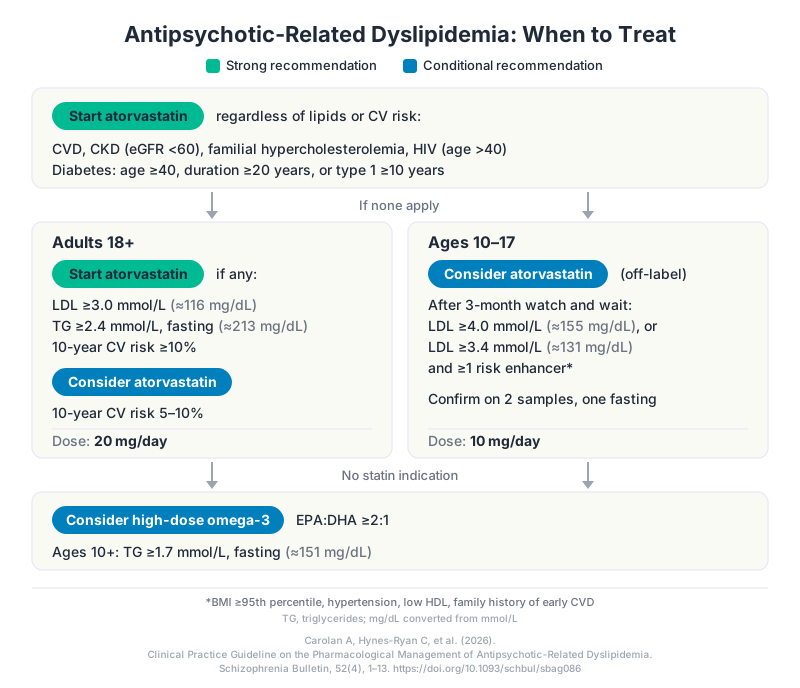
It was developed by a large multidisciplinary group that included experts from Psychiatry, Cardiology, Endocrinology, and Pharmacology, among others. They reviewed the literature and compared existing cholesterol guidelines, and they used state-of-the-art guideline development principles to write this clinical practice guideline with seven final recommendations plus a very straightforward one-page guideline algorithm.
Download PDF and other files
Atorvastatin as the Go-To Statin
The recommendations run from thresholds and indications for statins, derived from existing general cholesterol guidelines, to when to use high-dose omega-3 fatty acid supplements for high triglycerides. I will actually skip the exact threshold values and send you to the guideline itself for those details. I will point out, though, that the guideline proposes atorvastatin as your go-to statin, a moderate intensity statin with a fairly long half-life that makes administration easy.
Statins for Ages 10 to 17
Let me highlight what is truly novel. The guideline includes statin recommendations for children and adolescents from age 10 to 17, an age group that is usually ignored in guidelines because they are not considered to be at high risk for cardiovascular disease. The typical cardiovascular risk calculators do not even work for this age group. This ignores the fact that in this case we cause early high lipid levels with our medications, and the cumulative exposure to these levels sets into motion early atherogenesis that increases our young patients long-term cardiovascular risk.
Download PDF and other files
The Guideline in the Context of Current Psychiatric Practice
As for my second goal, let me begin by acknowledging that a modern psychiatrist is expected to pay attention to the physical health of their patients, in the spirit of mens sana in corpore sano, a healthy mind and a healthy body. Many professional organizations are explicit about this expectation.
The American Psychiatric Association, for example, has a position statement that notes clearly that psychiatrists are not just mental health providers but that, because of their training, they are also key players when it comes to keeping our patients physically healthy, particularly those with serious psychiatric disorders like psychotic disorders. I think most of us agree that metabolic monitoring for antipsychotics is our task, as we prescribe antipsychotics that increase weight and risk factors for cardiovascular disease, which is one factor in the increased mortality in our patients compared to their peers without psychiatric illness.
Few of Us Prescribe Lipid-Lowering Therapy
Now, there seems to be an assumption by the guideline developers that psychiatrists or other mental health prescribers would be best equipped and eager to take on this task of prescribing statins to patients on antipsychotics. Let me push back here a little bit.
In my program, the Massachusetts General Hospital Psychosis Clinical and Research Program, we have implemented guideline-concordant monitoring, which we consider our responsibility. I and many of my colleagues even prescribe metformin to blunt antipsychotic weight gain and reduce cardiometabolic risk for patients on high-risk antipsychotics like olanzapine or clozapine. But very few of us prescribe lipid-lowering medications.
Maybe that is on us — and on you too — and I certainly do not want to generalize from our very special setting here in an urban university hospital on the East Coast of the United States. I just want to bring this up because it highlights several challenges that get in my way, at least, but that you may also face.
Are you comfortable managing dyslipidemias beyond simply prescribing a statin? Managing dyslipidemias feels a bit outside my area of practice, even if prescribing atorvastatin would not make me terribly nervous. But one could argue that a more comprehensive approach should be taken, and that probably exceeds my abilities and time — and perhaps yours as well.
Even if you were comfortable managing dyslipidemias, what is the role of primary care then? Who is responsible for primary or secondary medical prevention? One concern I have is the diffusion of responsibility, where patients too may be confused about who is responsible for which medication.
Download PDF and other files
Advocacy May Be the Better Lever
Finally, the main concern that I have is this. Any task you take on has an opportunity cost, and one could argue that we really should focus on, say, smoking cessation.
Now, I want to be clear that I am not saying to never prescribe atorvastatin. I would just caution you against beginning to prescribe without taking the big picture view — looking at the treatment system within which you operate, and how it would support your prescribing.
In some countries like mine, medicolegal considerations become more pressing when you deviate from the usual scope of practice. That may also include the use of statins in children who do not have familial hypercholesterolemia, so a little bit of off-label prescribing.
Instead of prescribing myself, I may be best suited to become an advocate for improving the medical care of patients with serious mental illness who receive antipsychotics. Antipsychotic-related dyslipidemia may just be the next frontier waiting for my leadership and initiative to ensure that patients receive primary care that includes achieving lipid targets.
Bottom Line: A Call to Action
Here’s my bottom line for today. Antipsychotic-induced dyslipidemia has lived a bit under the shadow of more prominent metabolic concerns like prediabetes and diabetes, but it deserves to be addressed more forcefully given its association with cardiovascular disease. That is particularly true in children and adolescents, who many may not consider at high risk for increased lipid levels and who fall through the cracks of typical cardiovascular risk calculators.
We now have the first clinical practice guideline to support clinicians in Psychiatry and General Practice who want to initiate first-line treatment for antipsychotic-related dyslipidemia, including younger patients. The guideline is straightforward in principle, but who in your setting is going to implement it will be determined by your healthcare system, your resources and, importantly, how tasks are shared.
In that sense, I view this guideline more as a call to action for improving medical care for people with serious mental illness broadly, exemplified here with statin prescriptions for high cholesterol levels. That will require your leadership and a systems approach — not simply you starting to prescribe atorvastatin, unless of course this makes sense to you based on your training and your specific treatment setting and circumstances.
Download PDF and other files
Abstract
Clinical Practice Guideline on the Pharmacological Management of Antipsychotic-Related Dyslipidemia
Aoife Carolan; Caroline Hynes-Ryan; Rita Bourke, et al
Background
People taking antipsychotic medicines and those with severe mental illness experience elevated cardiovascular risk compared to the general population which is not adequately addressed by existing guidelines. Increases in lipid levels can occur soon after starting antipsychotics but often go untreated. Cumulative exposure to dyslipidemia from childhood, through young adulthood, facilitates atherogenesis. Regression of early lesions is possible; however, plaque progression can be irreversible, leading to sustained long-term cardiovascular risk. Although lipid-lowering therapies are effective at lowering cardiovascular risk, they are underutilized in this population. We have thus developed a clinical practice guideline for the pharmacological management of antipsychotic-related dyslipidemia.
Study Design
Using GRADE-ADOLOPMENT methodology, an international, multidisciplinary panel including experts-by-experience, developed a guideline for the pharmacological management of antipsychotic-related dyslipidemia. Literature was reviewed to answer key health questions. Patient important outcomes were identified. An evidence-to-decision framework informed the strength of recommendations and external reviews evaluated the rigor of the methods.
Study Results
Seven recommendations were developed on how and when to initiate lipid-lowering therapy based on specific criteria including established cardiovascular disease/high-risk conditions, cardiovascular risk assessment, or lipid parameter thresholds. A guideline algorithm illustrates the recommendations alongside supporting prescribing information.
Conclusions
This is the first clinical practice guideline for the management of antipsychotic-related dyslipidemia. The inclusion of recommendations for individuals aged 10 years and over represents a significant development. Implementation will be supported by shared decision-making resources including information videos and decision-aids.
Reference
Carolan, A.; Hynes-Ryan, C.; Bourke, R.; Columb, D.; Cullen, W.; deFerranti, S. et al. (2026). Clinical Practice Guideline on the Pharmacological Management of Antipsychotic-Related Dyslipidemia. Schizophr Bull; 52(4).